

Unlocking hidden iron power boosts sodium-ion battery performance
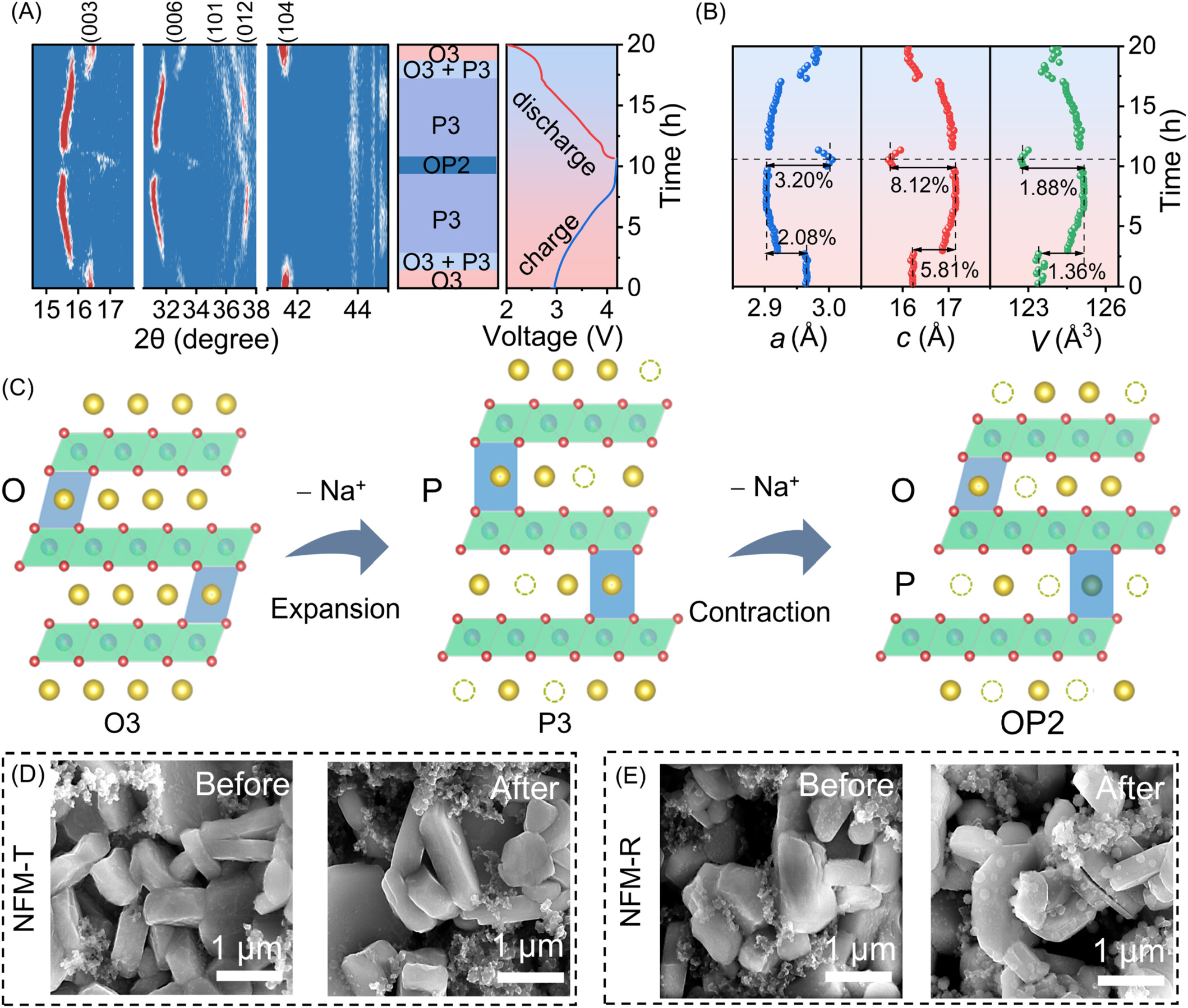
Phase/microstructure evolution.
GA, UNITED STATES, February 11, 2026 /EINPresswire.com/ -- Sodium-ion batteries are emerging as a promising alternative to lithium-based systems for large-scale energy storage, but their energy density has long been limited by the shallow redox activity of iron in layered oxide cathodes. A new materials design strategy now demonstrates that iron can contribute far more charge than previously thought. By deliberately altering the balance of transition metals, researchers unlocked a much deeper iron redox reaction, enabling significantly higher reversible capacity and energy density. The redesigned cathode combines enhanced electrochemical activity with structural stability, wide-temperature operability, and improved durability, offering a practical pathway toward next-generation sodium-ion batteries with performance levels once considered unattainable.
Layered transition-metal oxides are among the most promising cathode materials for sodium-ion batteries because of their high theoretical capacity and low cost. However, conventional designs rely on strict compositional symmetry to maintain charge balance, which unintentionally suppresses iron redox activity. As a result, iron typically contributes little to energy storage, leaving battery performance constrained. Attempts to raise capacity by adjusting metal ratios or increasing operating voltage often trigger structural instability or irreversible reactions, undermining long-term performance. Based on these challenges, it becomes necessary to explore new design strategies that fundamentally enhance iron redox activity while preserving structural integrity.
In a study published in Carbon Energy in 2025, researchers from Tianjin University of Technology and Shanghai Jiao Tong University report a valence-engineering strategy that fundamentally redefines how iron participates in sodium-ion battery cathodes. By intentionally breaking conventional transition-metal stoichiometric symmetry, the team designed a layered sodium oxide material in which iron undergoes an unusually deep and reversible redox process. This approach delivers substantially higher capacity and energy density than benchmark cathodes, while maintaining structural stability across a wide operating temperature range.
The researchers developed a layered sodium oxide cathode with a deliberately imbalanced ratio of nickel, iron, and manganese, reshaping iron's local electronic environment. Advanced theoretical calculations revealed that this configuration lowers the effective charge on iron atoms and raises their 3d orbital energy, making iron far more electrochemically active. Experimentally, iron was shown to reversibly cycle between unusually low and high oxidation states, transferring more than twice as many electrons per iron atom compared with conventional materials.
This deep iron redox directly translated into electrochemical gains. The new cathode delivered a reversible capacity exceeding 180 mAh g⁻¹ and achieved an energy density close to 600 Wh kg⁻¹—among the highest reported for layered sodium-ion cathodes. Importantly, these gains did not come at the expense of stability. In situ structural analyses revealed a highly reversible phase-transition pathway with minimal volume change, effectively suppressing microcracking and mechanical degradation.
The material also demonstrated robust performance across temperatures ranging from sub-zero conditions to elevated heat, highlighting its adaptability for real-world applications. Together, these results show that iron—long considered a weak contributor in sodium-ion batteries—can become a dominant charge carrier when its redox depth is properly unlocked.
"This work challenges the long-standing assumption that iron redox in layered sodium cathodes is intrinsically limited," an independent battery materials expert commented. "By rethinking charge balance at the atomic level, the researchers demonstrate that iron can deliver far more capacity than previously believed, without sacrificing structural stability. This is particularly important for sodium-ion batteries, where cost-effective and earth-abundant elements are essential. The study provides a clear design principle that could influence the development of high-energy cathodes well beyond this specific system."
The findings open new opportunities for sodium-ion batteries in grid-scale energy storage, renewable-energy buffering, and low-cost electric mobility. By maximizing the contribution of iron—an abundant and inexpensive element—the valence-engineering strategy reduces reliance on costly or scarce metals while simultaneously improving energy density. The demonstrated air stability, scalable synthesis, and successful full-cell performance further strengthen the case for practical deployment. More broadly, the concept of unlocking hidden redox depth through electronic-structure design may inspire similar advances in other battery chemistries, accelerating the transition toward safer, more sustainable, and high-performance energy storage technologies.
References
DOI
10.1002/cey2.70142
Original Source URL
https://doi.org/10.1002/cey2.70142
Funding information
This work was supported by the National Natural Science Foundation of China (Grant Nos. 52202282, 52402054, 22471283, and 52202327) and Natural Science Foundation of Tianjin City (Grant Nos. 22JCYBJC00040, 24JCQNJC00970).
Lucy Wang
BioDesign Research
email us here
Legal Disclaimer:
EIN Presswire provides this news content "as is" without warranty of any kind. We do not accept any responsibility or liability for the accuracy, content, images, videos, licenses, completeness, legality, or reliability of the information contained in this article. If you have any complaints or copyright issues related to this article, kindly contact the author above.
