

Heat Pump Industry Trends, Market Share, Demand, and Forecast Through 2032
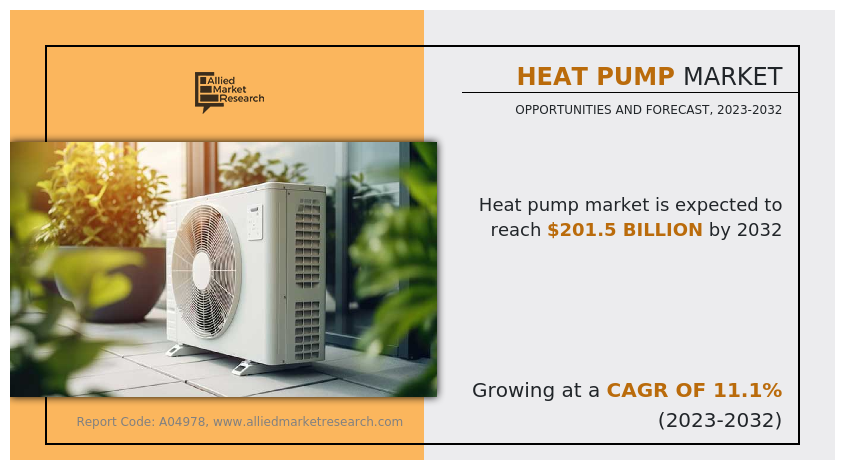
Heat pump market is projected to reach $201.5 billion by 2032 driven by HVAC demand and energy efficiency.
Growing focus on low-carbon heating and cooling solutions boosts global heat pump market growth worldwide.”
WILMINGTON, DE, UNITED STATES, May 29, 2026 /EINPresswire.com/ -- — Allied Market Research
According to a new report published by Allied Market Research, the heat pump market size was valued at $71.2 billion in 2022 and is projected to reach $201.5 billion by 2032, growing at a CAGR of 11.1% from 2023 to 2032. The rising adoption of energy-efficient HVAC systems, increasing focus on carbon emission reduction, and growing investments in sustainable building infrastructure are major factors driving the growth of the global heat pump market.
Download PDF Brochure: https://www.alliedmarketresearch.com/request-sample/5341
Introduction
Heat pumps are energy-efficient systems designed to transfer heat from one location to another using refrigeration cycle technology. These systems are capable of providing both heating and cooling, making them highly versatile for residential, commercial, and industrial applications. Heat pumps extract heat from outdoor air, ground, or water sources and transfer it indoors during colder seasons. During warmer conditions, the process is reversed to cool indoor spaces by removing heat.
The growing global emphasis on sustainable energy solutions and carbon reduction strategies has significantly increased the adoption of heat pumps worldwide. Governments, businesses, and consumers are actively shifting toward energy-efficient technologies that reduce electricity consumption and greenhouse gas emissions. As a result, the heat pump market is witnessing strong growth across developed and developing economies.
Heat pumps are increasingly replacing traditional heating and cooling systems due to their ability to reduce energy costs and improve environmental performance. Their dual-function capability, lower operating costs, and compatibility with renewable energy systems are positioning them as a preferred solution in modern infrastructure projects.
Growing Demand for Energy-Efficient HVAC Systems
The increasing demand for heating, ventilation, and air conditioning systems is one of the major factors fueling the growth of the heat pump market. Residential buildings, commercial facilities, and industrial operations rely heavily on HVAC systems to maintain indoor comfort, regulate humidity, and ensure operational efficiency.
Industrialization and urbanization are contributing significantly to the expansion of HVAC infrastructure worldwide. Manufacturing plants, office buildings, shopping complexes, hospitals, educational institutions, and data centers require advanced heating and cooling systems to support operational requirements and employee comfort.
Heat pumps offer a highly efficient alternative to traditional HVAC technologies by consuming less energy while delivering effective temperature control. This efficiency is particularly important as businesses and homeowners seek to reduce utility expenses and improve energy management.
The increasing construction of green buildings and energy-efficient infrastructure is further supporting the demand for advanced heat pump systems. Builders and developers are integrating heat pumps into modern construction projects to comply with environmental regulations and sustainability targets.
Heat Pumps Support Global Carbon Reduction Goals
Governments worldwide are implementing strict environmental policies and promoting low-carbon technologies to reduce greenhouse gas emissions. Heat pumps play a vital role in achieving these sustainability goals due to their high energy efficiency and reduced reliance on fossil fuels.
According to the International Energy Agency, heat pumps currently meet nearly 10% of the global building heating demand. However, the global inventory of heat pumps must increase significantly by 2030 to support the Net Zero Emissions by 2050 scenario. This growing need for decarbonization is expected to create substantial opportunities for the heat pump market during the forecast period.
Many countries are offering financial incentives, tax benefits, and subsidies to encourage consumers and businesses to adopt heat pump systems. These government initiatives are accelerating the transition toward clean heating and cooling technologies while improving market penetration globally.
The increasing integration of renewable energy sources such as solar and wind power with heat pump systems is also contributing to market expansion. Heat pumps can operate efficiently alongside renewable electricity generation, creating environmentally sustainable heating and cooling solutions.
Residential Sector Drives Heat Pump Market Growth
The residential sector remains one of the largest contributors to the heat pump market. Homeowners are increasingly adopting heat pumps for space heating, cooling, and water heating applications due to rising energy costs and growing environmental awareness.
Heat pumps are especially effective in moderate climates where temperature differences are less extreme. These systems provide year-round comfort while reducing electricity consumption compared to conventional heating technologies.
Heat pump water heaters are also gaining popularity in residential settings. These systems use surrounding air or ground heat to warm water, significantly reducing energy consumption compared to traditional electric water heaters. In many cases, heat pump water heaters can lower energy usage by up to 50%.
The growing demand for smart homes and connected appliances is further encouraging the adoption of advanced heat pump technologies. Consumers are increasingly seeking intelligent HVAC systems with remote monitoring, energy optimization, and automated temperature control features.
Technological Advancements Accelerating Innovation
Continuous innovation in heat pump technology is improving system performance, energy efficiency, and operational reliability. Manufacturers are investing heavily in research and development to introduce advanced heat pump solutions capable of operating effectively across various climate conditions.
For example, in November 2023, Mitsubishi Electric Corporation introduced an advanced aluminium vertical flat tube heat exchanger design for heat-pump air conditioners. This innovation significantly improves energy efficiency and reduces refrigerant requirements compared to conventional technologies.
Modern heat pumps now feature improved compressors, enhanced refrigerants, variable-speed motors, and smart sensors that optimize energy usage and improve temperature control. These advancements are making heat pumps more attractive for residential and commercial applications.
The integration of artificial intelligence and IoT technologies into HVAC systems is also transforming the heat pump market. Smart heat pumps can monitor energy consumption patterns, detect maintenance requirements, and adjust performance automatically to maximize efficiency.
These technological improvements are helping manufacturers meet increasingly strict environmental standards while enhancing customer satisfaction and reducing operating costs.
Procure This Report (300 Pages PDF with Insights, Charts, Tables, and Figures): https://www.alliedmarketresearch.com/heat-pump-market/purchase-options
Industrial Applications Strengthen Market Expansion
Industrial sectors are increasingly utilizing heat pump systems for process heating, cooling, and ventilation applications. Industries such as food processing, chemicals, pharmaceuticals, textiles, and manufacturing require stable temperature control and efficient energy management systems.
Heat pumps provide industrial facilities with a cost-effective solution for maintaining operational efficiency while reducing energy consumption and carbon emissions. Many industries are adopting industrial heat pump systems to improve sustainability and comply with environmental regulations.
The growing focus on energy optimization and waste heat recovery in industrial facilities is further supporting heat pump adoption. Industrial heat pumps can capture and reuse waste heat generated during production processes, improving overall energy efficiency.
As industrial infrastructure expands globally, the demand for high-capacity and technologically advanced heat pump systems is expected to rise significantly.
Market Challenges Restraining Growth
Despite strong growth prospects, certain challenges continue to limit the expansion of the heat pump market. One of the primary challenges is the high space requirement associated with some heat pump installations.
In densely populated urban environments, limited installation space can make it difficult to deploy larger heat pump systems. Older residential buildings may require structural modifications to accommodate heat pump equipment, increasing installation complexity and costs.
Initial installation costs can also be higher compared to traditional heating and cooling systems. Although heat pumps offer long-term energy savings, some consumers remain hesitant due to upfront investment requirements.
In colder regions with extreme winter temperatures, certain heat pump systems may experience reduced efficiency, requiring supplemental heating solutions. However, ongoing technological advancements are gradually improving cold-climate performance.
Technology Segmentation Analysis
The heat pump market is segmented by technology into air-to-air, air-to-water, water sourced, and other technologies. Among these, air-source heat pumps currently account for a substantial share of the market due to their cost-effectiveness and ease of installation.
Water sourced heat pumps are expected to witness the fastest growth during the forecast period, registering a CAGR of 11.6%. These systems utilize stable water temperatures to provide efficient heating and cooling performance, making them suitable for various residential and commercial applications.
Air-to-water heat pumps are also gaining traction in residential heating systems and hot water applications. These systems offer improved energy efficiency and can integrate effectively with radiant floor heating and smart home systems.
The growing focus on sustainable building technologies and renewable energy integration is expected to further drive innovation across all heat pump technology segments.
Capacity Segment Insights
Based on capacity, the heat pump market is categorized into up to 10Kw, 10 to 20Kw, 20 to 30Kw, and more than 30Kw systems. The up to 10Kw segment accounted for the largest revenue share in 2022, representing nearly one-third of the market.
This dominance is primarily attributed to strong demand from residential consumers seeking compact and energy-efficient heating and cooling solutions. Small-capacity heat pumps are widely used in homes, apartments, and small commercial facilities.
However, larger-capacity systems are expected to witness steady growth due to increasing industrial and commercial applications. High-capacity heat pumps are becoming increasingly important in large-scale buildings, industrial facilities, and district heating projects.
Asia-Pacific Emerges as Fastest Growing Region
Asia-Pacific represents the fastest-growing region in the global heat pump market, registering a CAGR of 11.4% during the forecast period. Rapid urbanization, rising energy demand, and increasing government support for energy-efficient technologies are driving regional market growth.
Countries such as China, Japan, South Korea, Australia, India, Singapore, and Malaysia are witnessing increased adoption of heat pump systems across residential and commercial sectors. Governments in these countries are implementing energy-efficiency standards and promoting low-carbon infrastructure development.
In Southeast Asia, heat pumps are increasingly used for water heating and air conditioning applications due to favorable climate conditions. Australia and New Zealand are also experiencing growing demand for heat pumps as part of efforts to reduce greenhouse gas emissions and improve building energy efficiency.
The expansion of smart cities, green buildings, and sustainable infrastructure projects across Asia-Pacific is expected to create significant opportunities for heat pump manufacturers.
Competitive Landscape and Strategic Developments
The global heat pump market is highly competitive, with leading manufacturers focusing on technological innovation, product development, strategic partnerships, and market expansion initiatives.
Major companies operating in the market include DAIKIN INDUSTRIES Ltd., Mitsubishi Electric Corporation, Carrier, Panasonic Corporation, Trane Technologies plc, Lennox International Inc., Bosch Thermotechnology Corp, NIBE GROUP, FUJITSU GENERAL, and SAMSUNG.
These companies are investing heavily in advanced HVAC technologies, environmentally friendly refrigerants, and smart energy management systems to strengthen their market positions. Manufacturers are also expanding production capacities and distribution networks to meet rising global demand.
Strategic collaborations with governments, utility providers, and construction companies are helping industry players accelerate heat pump adoption across multiple applications.
Get a Customized Research Report: https://www.alliedmarketresearch.com/request-for-customization/5341
Future Outlook of the Heat Pump Market
The future of the heat pump market appears highly promising as global demand for sustainable heating and cooling technologies continues to rise. Increasing awareness regarding energy conservation, climate change mitigation, and carbon reduction is expected to drive long-term market growth.
The integration of renewable energy systems, smart grid technologies, and intelligent building management platforms will further enhance the efficiency and adoption of heat pumps worldwide. Continued innovation in compressor technology, refrigerants, and heat exchanger design is expected to improve performance and reduce operational costs.
As governments continue implementing energy-efficiency policies and consumers prioritize environmentally responsible technologies, heat pumps are expected to become an essential component of modern residential, commercial, and industrial infrastructure.
With expanding investments in green buildings, renewable energy, and digital HVAC technologies, the global heat pump market is anticipated to witness substantial growth opportunities through 2032.
Trending Reports in Energy and Power Industry:
Heat Pumps Market
https://www.alliedmarketresearch.com/heat-pump-market
Industrial Heat Pump Market
https://www.alliedmarketresearch.com/industrial-heat-pump-market-A47269
Geothermal Heat Pump Market
https://www.alliedmarketresearch.com/geothermal-heat-pump-market-A10486
Residential Heat Pump Market
https://www.alliedmarketresearch.com/residential-heat-pump-market-A15982
Heat Exchanger Market
https://www.alliedmarketresearch.com/heat-exchanger-market
Taiwan Commercial Air Conditioning System Market
https://www.alliedmarketresearch.com/taiwan-commercial-air-conditioning-system-market-A325817
Air Conditioning Equipment Market
https://www.alliedmarketresearch.com/air-conditioning-equipment-market
Commercial Air Conditioning System Market
https://www.alliedmarketresearch.com/commercial-air-conditioning-system-market-A78146
Underfloor Heating Market
https://www.alliedmarketresearch.com/underfloor-heating-market-A06488
Gasketed Plate Heat Exchanger Market
https://www.alliedmarketresearch.com/gasketed-plate-heat-exchanger-market-A31025
India Heat Exchangers Market
https://www.alliedmarketresearch.com/india-heat-exchangers-market
Electric Water Heater Market
https://www.alliedmarketresearch.com/electric-water-heater-market-A13788
Solar Water Heater Market
https://www.alliedmarketresearch.com/solar-water-heater-market-A07957
Gas Water Heater Market
https://www.alliedmarketresearch.com/gas-water-heater-market-A16958
Tankless Water Heater Market
https://www.alliedmarketresearch.com/global-tankless-water-heater-market-A16572
Commercial Heat Pump Water Heater Market
https://www.alliedmarketresearch.com/commercial-heat-pump-water-heater-market-A14520
Storage Water Heater Market
https://www.alliedmarketresearch.com/storage-water-heater-market-A14855
Solar Thermal Market
https://www.alliedmarketresearch.com/solar-thermal-market-A06891
About Us
Allied Market Research (AMR) is a full-service market research and business-consulting wing of Allied Analytics LLP based in Portland, Oregon. Allied Market Research provides global enterprises as well as medium and small businesses with unmatched quality of "Market Research Reports" and "Business Intelligence Solutions." AMR has a targeted view to provide business insights and consulting to assist its clients to make strategic business decisions and achieve sustainable growth in their respective market domain.
Pawan Kumar, the CEO of Allied Market Research, is leading the organization toward providing high-quality data and insights. We are in professional corporate relations with various companies and this helps us in digging out market data that helps us generate accurate research data tables and confirms utmost accuracy in our market forecasting. Each and every data presented in the reports published by us is extracted through primary interviews with top officials from leading companies of domain concerned. Our secondary data procurement methodology includes deep online and offline research and discussion with knowledgeable professionals and analysts in the industry.
David Correa
Allied Market Research
+ + + + + + + + + + + + +1 800-792-5285
email us here
Visit us on social media:
LinkedIn
Facebook
YouTube
X
Legal Disclaimer:
EIN Presswire provides this news content "as is" without warranty of any kind. We do not accept any responsibility or liability for the accuracy, content, images, videos, licenses, completeness, legality, or reliability of the information contained in this article. If you have any complaints or copyright issues related to this article, kindly contact the author above.
