

Agrivoltaics Industry Forecast 2031: Renewable Energy and Agriculture Converge
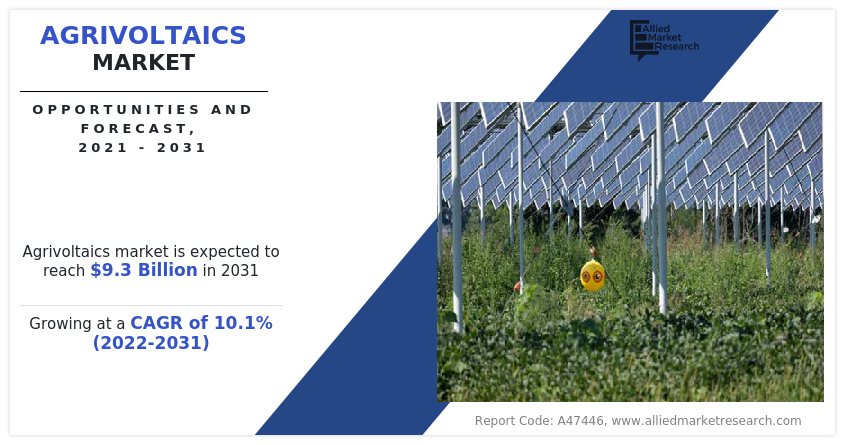
Agrivoltaics market is projected to reach $9.3 billion by 2031, driven by clean energy adoption and sustainable farming.
Growing solar installations and agricultural sustainability initiatives fuel global agrivoltaics market growth through 2031.”
WILMINGTON, DE, UNITED STATES, June 3, 2026 /EINPresswire.com/ -- — Allied Market Research
The global agrivoltaics market is gaining significant momentum as governments, farmers, and renewable energy developers seek innovative ways to address food security challenges while accelerating the transition toward clean energy. According to a recent report published by Allied Market Research, the agrivoltaics market size was valued at $3.6 billion in 2021 and is projected to reach $9.3 billion by 2031, registering a CAGR of 10.1% from 2022 to 2031.
The growing pressure on agricultural land, increasing energy demand, climate change concerns, and the need for sustainable resource utilization have positioned agrivoltaics as one of the most promising solutions in the renewable energy sector. By enabling simultaneous agricultural production and solar power generation on the same land, agrivoltaics creates a unique synergy that maximizes land productivity and supports environmental sustainability.
Download PDF Brochure: https://www.alliedmarketresearch.com/request-sample/A47446
As countries strive to reduce greenhouse gas emissions while ensuring stable food supplies, the adoption of agrivoltaic systems is expected to accelerate across both developed and emerging economies.
Understanding Agrivoltaics and Its Growing Importance
Agrivoltaics refers to the practice of integrating solar photovoltaic systems with agricultural activities on the same parcel of land. Instead of dedicating land exclusively to either farming or solar energy generation, agrivoltaic systems allow both activities to coexist, delivering multiple economic and environmental benefits.
The concept addresses one of the biggest challenges facing modern societies: land-use competition. Agricultural land is increasingly under pressure from urbanization, industrial development, and renewable energy projects. Agrivoltaics provides an innovative solution by allowing solar panels to generate electricity while crops continue to grow underneath or around them.
This dual-use approach helps farmers diversify revenue streams, improve land efficiency, and contribute to renewable energy generation without sacrificing agricultural productivity. The technology also supports sustainable rural development and biodiversity preservation, making it an attractive option for policymakers and environmental organizations worldwide.
Market Overview and Growth Outlook
The agrivoltaics market has experienced remarkable growth over the past decade. Technological advancements, increasing awareness of renewable energy benefits, and rising concerns regarding climate resilience have contributed to wider adoption of agrivoltaic systems.
The global installed capacity of agrivoltaic projects increased dramatically from approximately 5 MW in 2012 to nearly 2.9 GW by 2020. This rapid expansion demonstrates growing confidence in the technology and its ability to address both energy and agricultural challenges.
As governments continue implementing clean energy policies and sustainability initiatives, demand for agrivoltaic installations is expected to increase significantly. The market’s projected growth to $9.3 billion by 2031 highlights the increasing importance of integrated land-use solutions in achieving long-term environmental and economic goals.
Rising Demand for Clean Energy Fuels Market Expansion
One of the primary drivers of the agrivoltaics market is the growing demand for renewable energy. Governments worldwide are setting ambitious decarbonization targets and investing heavily in solar power infrastructure to reduce dependence on fossil fuels.
Solar energy remains one of the fastest-growing renewable energy sources globally. However, large-scale solar projects often require substantial land resources, creating competition with agricultural activities. Agrivoltaics resolves this challenge by enabling solar power generation without displacing farming operations.
The ability to simultaneously produce food and renewable energy makes agrivoltaic systems highly attractive for regions facing land scarcity. As energy demand continues to rise, agrivoltaics is emerging as a practical solution that balances energy production with agricultural sustainability.
Climate Change and Water Conservation Benefits
Climate change is significantly impacting agricultural productivity through rising temperatures, droughts, unpredictable rainfall patterns, and extreme weather events. Agrivoltaics offers several advantages that help farmers adapt to these changing environmental conditions.
Solar panels provide partial shading for crops, reducing heat stress and protecting plants from excessive sunlight exposure. This controlled shading can improve crop resilience during periods of extreme heat while reducing water evaporation from the soil.
Lower soil temperatures help retain moisture, reducing irrigation requirements and improving water-use efficiency. These benefits are particularly important in arid and semi-arid regions where water scarcity threatens agricultural production.
Agrivoltaic systems also provide protection against severe weather conditions such as hailstorms, heavy rainfall, and strong winds. By acting as physical barriers, solar panels help minimize crop damage and improve agricultural stability.
Supporting Food Security Through Dual Land Use
Food security remains a major concern for many countries due to population growth, shrinking arable land, and climate-related disruptions. Agrivoltaics provides an innovative pathway to maintain agricultural productivity while supporting renewable energy development.
Rather than converting farmland into dedicated solar facilities, agrivoltaic projects allow farmers to continue cultivating crops while generating electricity. This dual-use model ensures that agricultural production remains intact while creating additional economic value from the same land area.
Many experts believe agrivoltaics can play a critical role in addressing future food security challenges by maximizing resource utilization. As agricultural land becomes increasingly scarce, integrated systems that support multiple functions will become increasingly valuable.
Technological Advancements Accelerating Adoption
Technological innovation is a major factor driving the agrivoltaics market forward. Improvements in solar panel efficiency, mounting structures, tracking systems, and agricultural monitoring technologies have enhanced the viability of agrivoltaic installations.
Modern agrivoltaic systems are designed to optimize both crop growth and solar energy generation. Advanced engineering allows solar panels to be installed at heights and angles that minimize interference with farming operations while maximizing sunlight capture.
Dynamic agrivoltaic systems represent one of the most promising developments in the sector. These systems utilize movable solar panels that can adjust their position based on weather conditions, sunlight availability, and crop requirements.
Additionally, the integration of digital technologies such as sensors, artificial intelligence, and data analytics enables real-time monitoring of environmental conditions, helping farmers optimize productivity and resource management.
Procure This Report (312 Pages PDF with Insights, Charts, Tables, and Figures): https://www.alliedmarketresearch.com/agrivoltaics-market/purchase-options
Government Policies and Financial Incentives
Government support plays a crucial role in promoting agrivoltaic adoption. Financial incentives, subsidies, tax benefits, and favorable regulatory frameworks are helping reduce investment barriers and encourage project development.
Many countries have recognized agrivoltaics as a strategic solution for achieving renewable energy and agricultural sustainability goals simultaneously. Public-private partnerships, low-interest financing programs, and land-use incentives are contributing to market expansion.
Policy frameworks that encourage collaboration between farmers, renewable energy developers, and financial institutions are creating favorable conditions for long-term growth. Continued government support is expected to remain essential as the agrivoltaics market matures.
Challenges Facing the Agrivoltaics Market
Despite its strong growth potential, the agrivoltaics market faces several challenges that could impact adoption rates. One of the primary concerns is the potential reduction in crop yields if solar installations are not properly designed.
Different crops have varying sunlight requirements, making system optimization critical. Excessive shading can negatively affect certain crops, while inadequate spacing may hinder agricultural operations.
The absence of standardized regulations and technical guidelines across countries also creates uncertainty for project developers. Regulatory inconsistencies can complicate permitting processes and delay project implementation.
High initial investment costs remain another barrier, particularly for small-scale farmers. Agrivoltaic systems often require specialized structures and engineering solutions, resulting in higher upfront expenses compared to traditional farming or solar installations.
Segment Analysis: Fixed Solar Panels Lead the Market
Based on system design, fixed solar panel systems accounted for the largest share of the agrivoltaics market in 2021 and are expected to maintain their dominance throughout the forecast period.
Fixed solar panels offer several advantages, including lower installation costs, simpler maintenance requirements, and reliable power generation. Unlike dynamic systems that require regular movement and adjustments, fixed systems provide operational simplicity and reduced maintenance complexity.
The ease of handling and consistent energy production capabilities make fixed solar panels a preferred choice for large-scale agrivoltaic projects. Their proven performance and economic viability continue to drive widespread adoption across various agricultural applications.
Cell Type Trends Shaping Market Development
The cell type segment plays a significant role in determining overall system efficiency and project economics. High-performance photovoltaic cells are increasingly being utilized to maximize electricity generation while maintaining compatibility with agricultural operations.
Advanced solar cell technologies provide improved conversion efficiencies, enabling developers to generate more electricity from limited land areas. Continuous innovation in photovoltaic materials and manufacturing processes is expected to further enhance system performance and support market growth.
As solar technology continues evolving, agrivoltaic projects are likely to benefit from increased energy output, lower costs, and improved long-term profitability.
Crop Applications Driving Market Demand
Crop cultivation remains the dominant application area within the agrivoltaics market. Farmers are increasingly recognizing the benefits of integrating solar infrastructure with crop production systems.
The crop segment held the largest market share in 2021 due to growing concerns regarding extreme weather events and water scarcity. Solar panels help shield crops from excessive heat and dehydration, creating more favorable growing conditions.
Vegetables, fruits, and specialty crops are also gaining attention within agrivoltaic systems. Research indicates that certain crops can thrive under partial shading conditions, benefiting from reduced temperature stress and improved moisture retention.
As understanding of crop-specific agrivoltaic applications expands, adoption across diverse agricultural sectors is expected to increase significantly.
Regional Analysis: North America Leads the Market
North America emerged as the largest regional market in 2021 and is expected to maintain its leadership position during the forecast period. The region’s dominance is attributed to declining availability of arable land, growing renewable energy investments, and strong policy support for sustainable development.
The United States has witnessed increasing interest in agrivoltaic projects as farmers seek additional revenue opportunities while contributing to clean energy generation. Research institutions, government agencies, and private developers are actively exploring innovative agrivoltaic models to improve land-use efficiency.
The region’s focus on climate resilience and agricultural sustainability further supports market expansion.
Future Opportunities and Market Outlook
The future of the agrivoltaics market appears highly promising as global efforts to address climate change, food security, and energy sustainability continue to intensify. Growing investments in renewable energy infrastructure, advancements in solar technology, and increasing awareness among farmers are expected to drive widespread adoption.
Emerging markets across Asia-Pacific, Europe, and Latin America present substantial growth opportunities due to rising energy demand and agricultural modernization initiatives. Continued innovation and supportive policy frameworks will play a vital role in unlocking the full potential of agrivoltaic systems.
As stakeholders increasingly recognize the value of dual-use land management strategies, agrivoltaics is expected to become a key component of sustainable agricultural and energy development worldwide.
Get a Customized Research Report: https://www.alliedmarketresearch.com/request-for-customization/A47446
Conclusion
The agrivoltaics market is transforming the way land resources are utilized by enabling simultaneous food production and renewable energy generation. Valued at $3.6 billion in 2021 and projected to reach $9.3 billion by 2031, the market reflects growing global demand for innovative solutions that balance agricultural productivity with clean energy goals.
Driven by climate resilience, land-use optimization, government support, and technological advancements, agrivoltaics offers significant economic and environmental benefits. As countries continue investing in sustainable development strategies, agrivoltaic systems are poised to play a crucial role in shaping the future of agriculture and renewable energy.
Trending Reports in Energy and Power Industry:
Agrivoltaics Market
https://www.alliedmarketresearch.com/agrivoltaics-market-A47446
Thermophotovoltaics Market
https://www.alliedmarketresearch.com/thermophotovoltaics-market-A74594
Building Integrated Photovoltaic (BIPV) Market
https://www.alliedmarketresearch.com/building-integrated-photovoltaic-market
Photovoltaic Market
https://www.alliedmarketresearch.com/photovoltaic-market
Solar Photovoltaic (PV) Panel Market
https://www.alliedmarketresearch.com/solar-photovoltaic-panel-market
Floating Photovoltaics (FPV) Market
https://www.alliedmarketresearch.com/floating-photovoltaics-fpv-market-A53704
Stationary Floating Solar Panel Market
https://www.alliedmarketresearch.com/stationary-floating-solar-panel-market-A151448
Floating Solar Panels Market
https://www.alliedmarketresearch.com/floating-solar-panels-market-A08056
Solar Photovoltaic Glass Market
https://www.alliedmarketresearch.com/solar-photovoltaic-glass-market
Rooftop Solar Photovoltaic (PV) Installation Market
https://www.alliedmarketresearch.com/rooftop-solar-photovoltaic-PV-installation-market
Solar Photovoltaic (PV) Installations Market
https://www.alliedmarketresearch.com/solar-photovoltaic-PV-installations-market
Renewable Energy Market
https://www.alliedmarketresearch.com/renewable-energy-market
U.S. Clean Energy Market
https://www.alliedmarketresearch.com/us-clean-energy-market-A325461
Clean Energy Market
https://www.alliedmarketresearch.com/clean-energy-market-A43785
Green Energy Market
https://www.alliedmarketresearch.com/green-energy-market
Green Power Market
https://www.alliedmarketresearch.com/green-power-market-A07575
About Us
Allied Market Research (AMR) is a full-service market research and business-consulting wing of Allied Analytics LLP based in Portland, Oregon. Allied Market Research provides global enterprises as well as medium and small businesses with unmatched quality of "Market Research Reports" and "Business Intelligence Solutions." AMR has a targeted view to provide business insights and consulting to assist its clients to make strategic business decisions and achieve sustainable growth in their respective market domain.
Pawan Kumar, the CEO of Allied Market Research, is leading the organization toward providing high-quality data and insights. We are in professional corporate relations with various companies and this helps us in digging out market data that helps us generate accurate research data tables and confirms utmost accuracy in our market forecasting. Each and every data presented in the reports published by us is extracted through primary interviews with top officials from leading companies of domain concerned. Our secondary data procurement methodology includes deep online and offline research and discussion with knowledgeable professionals and analysts in the industry.
David Correa
Allied Market Research
+ + + + + + + + + + + + +1 800-792-5285
email us here
Visit us on social media:
LinkedIn
Facebook
YouTube
X
Legal Disclaimer:
EIN Presswire provides this news content "as is" without warranty of any kind. We do not accept any responsibility or liability for the accuracy, content, images, videos, licenses, completeness, legality, or reliability of the information contained in this article. If you have any complaints or copyright issues related to this article, kindly contact the author above.
